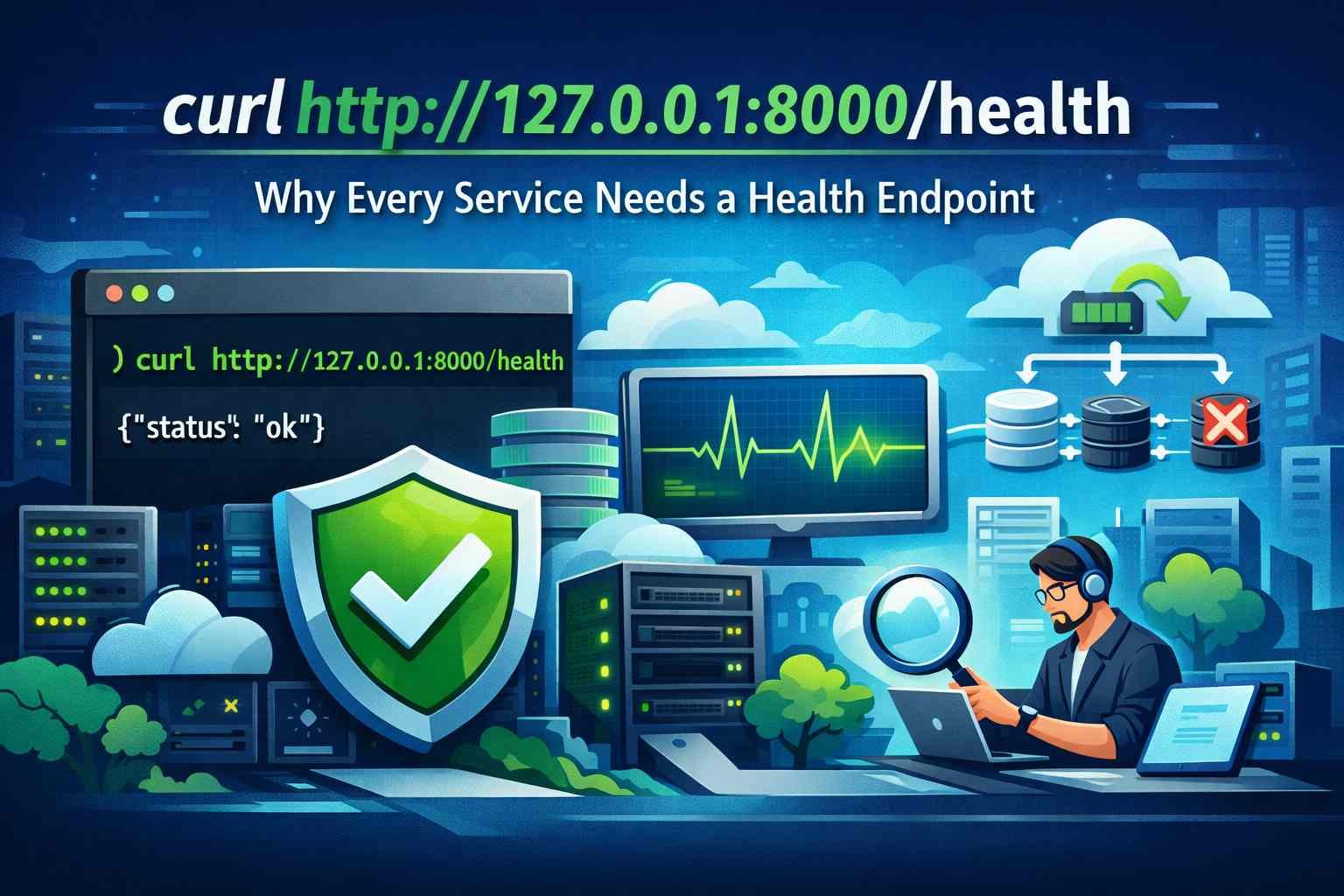
curl http://127.0.0.1:8000/health : Why Every Service Needs a Health Endpoint
In modern software systems, reliability is not a luxury—it is a requirement. Whether you are running a small side project, a startup MVP, or a globally distributed platform, your services must be observable, predictable, and resilient. One of the simplest yet most powerful tools to achieve this is a health endpoint.
If you have ever typed a command like:
you have already interacted with one of the most important building blocks of production-grade systems. This article explores what a health endpoint is, why every service needs one, how it fits into modern architectures, and best practices for implementing it correctly.
What Is a Health Endpoint?
A health endpoint is an HTTP endpoint—commonly /health, /healthz, or /status—that reports whether a service is running correctly. It is typically accessed using simple tools like curl, browsers, or automated systems.
At its simplest, a health endpoint might return:
At a more advanced level, it may report the status of databases, message queues, caches, and external dependencies.
The key idea is simple:
A health endpoint answers the question: “Is this service healthy enough to do its job?”
Why Health Endpoints Matter
1. Services Fail More Often Than You Think
In distributed systems, failure is normal. Networks glitch, disks fill up, databases restart, certificates expire, and dependencies go offline. A service that looks alive (because the process is running) may still be completely unusable.
A health endpoint provides a machine-readable signal that distinguishes between:
- Process is running
- Service is actually functional
2. Automation Depends on Health Checks
Modern infrastructure is automated. Load balancers, container orchestrators, and deployment pipelines all rely on health endpoints to make decisions.
Examples include:
- Removing unhealthy instances from traffic
- Restarting crashed services
- Rolling back failed deployments
- Scaling services up or down
- Without a health endpoint, automation is blind.
3. Faster Debugging and Incident Response
When something goes wrong, engineers ask:
- Is the service up?
- Is it partially degraded?
- Is it failing because of a dependency?
A well-designed health endpoint provides immediate answers—often without needing logs or shell access.
Running:
can instantly tell you whether the service itself thinks it is healthy.
Health Endpoints in Local Development
Health endpoints are not just for production.
During local development, they help you:
- Verify the server started correctly
- Confirm configuration and environment variables are valid
- Detect missing dependencies (e.g., database not running)
A failing /health endpoint during development often saves hours of confusion later.
Health Endpoints in Production
In production, health endpoints are critical for resilience and uptime.
Load Balancers
Load balancers periodically check health endpoints to decide which instances should receive traffic. If /health fails, traffic is rerouted automatically.
Containers and Orchestration
Container platforms rely on health checks to:
- Restart crashed containers
- Stop routing traffic to unhealthy pods
- Perform safe rolling updates
Monitoring and Alerting
Monitoring systems poll health endpoints and trigger alerts when something is wrong—often before users notice.
Types of Health Checks
Not all health checks are equal. Understanding the different types is essential.
1. Liveness Checks
Question: Is the service running at all?
A liveness check answers whether the process should be restarted. It should be:
- Very fast
- Very simple
- Independent of external dependencies
Example response:
2. Readiness Checks
Question: Is the service ready to receive traffic?
A service might be alive but not ready due to:
- Database migrations in progress
- Cache warming
- Dependency outages
Readiness checks determine whether traffic should be sent to the service.
3. Deep Health Checks
Question: Are all critical dependencies functioning?
These checks may include:
- Database connectivity
- Message queue availability
- External API reachability
They provide richer diagnostics but must be designed carefully to avoid slowness or cascading failures.
What Should a Health Endpoint Return?
A good health endpoint is:
- Deterministic – no randomness
- Fast – milliseconds, not seconds
- Stable – predictable response structure
- Machine-readable – JSON is preferred
Example Response
HTTP status codes also matter:
200 OK→ Healthy503 Service Unavailable→ Unhealthy
Security Considerations
Health endpoints should be designed with security in mind.
What to Avoid
- Leaking credentials
- Exposing internal IPs or stack traces
- Returning detailed dependency errors publicly
Common Practices
- Expose minimal information publicly
- Use authentication for deep health checks
- Bind sensitive endpoints to internal networks only
Common Mistakes
1. Making Health Checks Too Heavy
Calling external services or running expensive queries can slow down your system and cause false failures.
2. Always Returning 200 OK
If a service always reports healthy, the endpoint becomes useless.
3. Mixing Health with Metrics
Health endpoints should answer “Am I okay?”
Metrics answer “How well am I performing?”
Keep them separate.
Designing a Minimal Health Endpoint
A minimal yet effective health endpoint:
- Returns quickly
- Indicates basic service status
- Uses appropriate HTTP status codes
Example behavior:
- Service started successfully → healthy
- Critical config missing → unhealthy
- Dependency required for core functionality unavailable → unhealthy
Why curl Is Enough
The beauty of health endpoints is their simplicity.
Using:
You can:
- Test locally
- Debug remotely
- Script checks
- Integrate with CI/CD pipelines
No special tools required.
Health Endpoints as a Contract
Think of a health endpoint as a contract between your service and the infrastructure.
If the service lies, the system breaks.
If the service is honest, the system becomes resilient.
Best Practices Summary
- Always implement a health endpoint
- Separate liveness and readiness checks
- Keep responses fast and simple
- Use meaningful HTTP status codes
- Avoid exposing sensitive details
- Treat health endpoints as production-critical APIs
Frequently Asked Questions (FAQ)
Q1: Is a health endpoint required for small applications?
Yes. Even small applications benefit from easier debugging, automation, and future scalability.
Q2: Should health endpoints check the database?
Only if the database is critical for core functionality. Avoid unnecessary dependency checks.
Q3: Can health endpoints be cached?
No. Health endpoints should always return real-time information.
Q4: What is the difference between /health and /status?
There is no strict standard. /health is more commonly associated with machine checks, while /status may be more human-readable.
Q5: Should health endpoints be public?
Basic health endpoints often are, but detailed checks should be restricted or internal.
Q6: How often should health endpoints be checked?
Typically every few seconds, depending on system requirements and tolerance for failure.
Disclaimer
This article is intended for educational and informational purposes only. The concepts and examples described here may not be suitable for all systems or environments. Security requirements, performance constraints, and architectural decisions vary widely between applications. Always evaluate health check designs in the context of your own infrastructure, compliance requirements, and operational needs. The author assumes no responsibility for system outages, security issues, or operational failures resulting from the implementation of ideas discussed in this article.
Final Thoughts
A health endpoint is one of the smallest features you can build—and one of the most impactful. It costs little, adds enormous value, and forms the foundation of reliable, automated, and observable systems.
If your service does not yet respond to: