Most institutions holding a significant personal archive have the same quiet problem. The material is extraordinary, and almost nobody reads it. Recordings sit in catalogues. Letters sit in boxes. The people most likely to be changed by the material are the least likely to go looking for it.
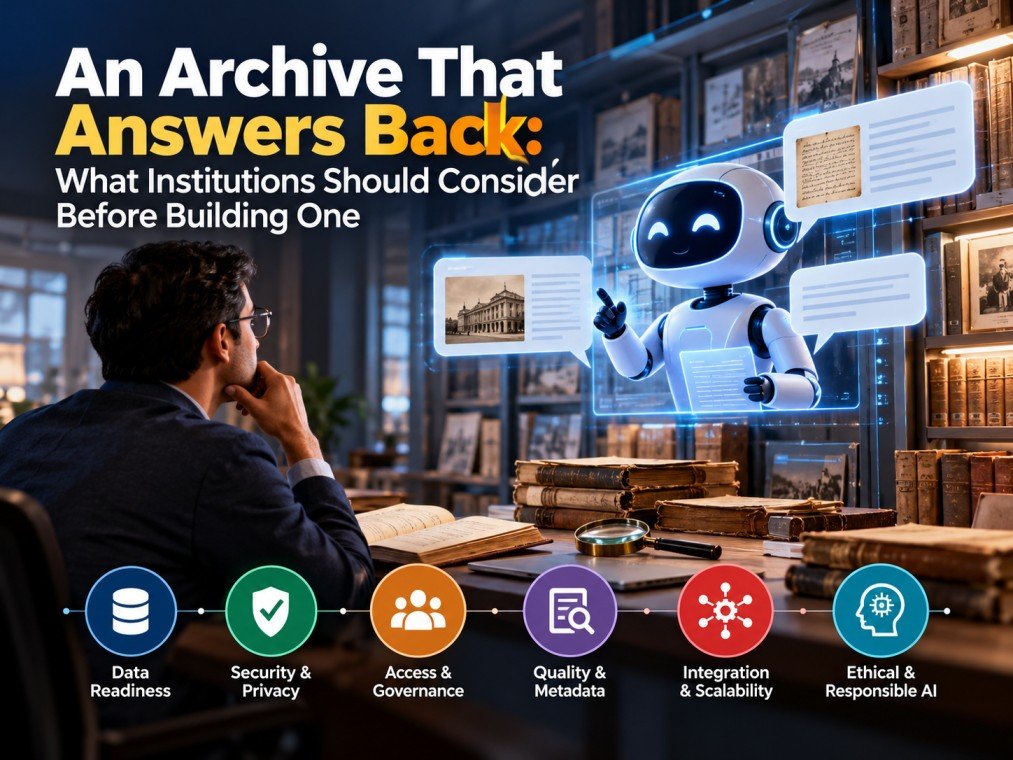
Conversational interfaces offer a different route in: a visitor asks a question in their own words and the archive answers. It is a genuinely promising idea, and it carries obligations that a display case does not. We have written separately on the decisions a venue should make before commissioning one.
What it is good at
Three things, in our experience. It reaches people who would never open the book, particularly younger visitors. It answers the questions people actually have rather than the ones the curator anticipated. And it works in whatever language the visitor brings, which matters in institutions whose audience is more diverse than their written material.
There is a fourth benefit that institutions rarely expect. Every question asked is recorded feedback about what visitors actually want to know, and that list is almost never the same as what the signage assumes.
What it cannot do
It cannot fill gaps in the archive. If the material does not cover a subject, the honest response is to say so. Any system that generates a plausible answer in that situation has stopped representing the archive and started inventing it, and for an institution whose authority rests on accuracy that is the worst possible outcome.
It also cannot settle contested interpretation. Where scholars disagree, a single confident voice misrepresents the state of knowledge. This is a content and governance decision long before it is a technical one.
Governance that should exist before the build
The question to settle first
Not which technology, but what the thing is for. An interface that helps a visitor find their way around a building is a different project from one that lets them ask a scholar about their life’s work. Institutions that start from the archive and the audience end up with something durable. Institutions that start from the technology end up with a screen that people photograph once.
Who inside the institution needs to be involved
These projects fail on governance more often than on technology, and the usual cause is a team that is too small. Curatorial or academic staff decide what the archive contains and where interpretation is contested. Communications owns the public voice. Legal handles rights and data. Front-of-house staff know how visitors actually behave in the space, and they are the most frequently forgotten and the most useful.
One named person should be able to approve a change to what the system may say. Where that authority is unclear, updates stall and the installation slowly drifts out of date, which is how a flagship exhibit becomes an embarrassment within a year.
Accessibility is not a later phase
A conversational interface is a gift to some visitors and a barrier to others. People who cannot speak aloud, or would rather not in a public hall, need a touch route to the same content. Deaf and hard-of-hearing visitors need captions on every spoken reply, including the clarifying questions and the refusals. Children and first-time users benefit from a simpler mode.
These decisions shape the hardware, which is why they cannot be added afterwards. Screen size, viewing height, caption space and whether there is a keypad at all are set when the enclosure is designed.
Budgeting honestly
Institutions routinely underestimate two costs. The first is content: preparing, approving and maintaining the corpus is staff time, and it does not stop at launch. The second is running cost: AI and speech services, monitoring and periodic review are ongoing, not one-off.
Ask any vendor for the build price and the monthly running cost as separate figures, and ask what happens to the installation if the organisation stops paying the second. An exhibit that silently degrades is worse than one that was never installed.
Start with a pilot you can actually judge
One location, one job, four to eight weeks, with the measures of success written down before it opens. Useful ones include conversations started as a share of footfall, questions answered without staff help, languages used, and the most common unanswered questions. Add what visitors and front-of-house staff say about it, because they will notice things the numbers miss.
If the pilot goes well you will have evidence to expand. If it does not, you will know whether the problem was the purpose, the room, the content or the technology, which is worth nearly as much and considerably cheaper to learn at this scale.
The test we suggest is simple. If the installation were switched off tomorrow, would anyone miss what it did? If the answer is no, the project needed a clearer purpose before it needed a vendor.