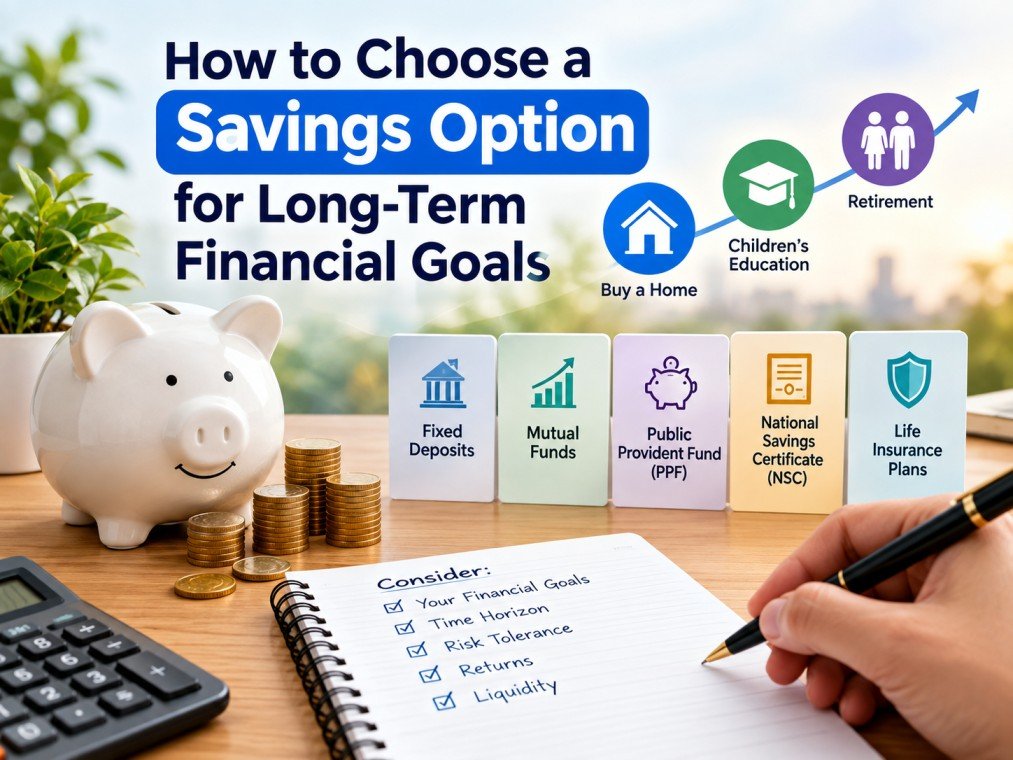
Saving for a goal that is five, ten, or twenty years away requires a different approach from simply keeping aside whatever money remains at the end of each month. Long-term goals need a target amount, a realistic timeline, regular contributions, and a financial product that matches your expectations around risk and access to money.
For Indian households, these goals can range from children’s education and buying a house to retirement planning and creating greater financial security for the family. The right saving approach depends on what you are trying to achieve rather than which product appears most attractive at first glance.
Define Exactly What You Are Saving For
Start by attaching a purpose to your savings.
Instead of deciding that you want to accumulate a large amount over the next decade, identify the actual expense. You might be preparing for your child’s higher education, building a retirement corpus, or saving towards another major family responsibility.
Once the goal is clear, estimate its current cost and then consider how inflation could affect it.
This gives you a future target rather than an arbitrary savings number.
Decide How Much You Can Commit Regularly
Your contribution should fit comfortably within your current finances.
Calculate your monthly income and subtract essential household expenses, EMIs, insurance premiums, emergency savings, and other unavoidable commitments.
The remaining amount can help you determine how much you can realistically allocate towards long-term goals.
When searching for the best savings plan, avoid defining “best” purely by the highest maturity value. A product is useful only if its contribution requirements, tenure, benefits, and conditions work with your financial situation.
Understand the Difference Between Saving and Protection
Some financial products focus primarily on accumulating money, while others combine savings with life insurance protection.
This distinction matters when you have family members who depend on your income.
If you are considering an Endowment Policy, understand both the savings and insurance components. Check the applicable maturity benefits as well as the life cover provided under the policy.
Then compare that protection with your family’s actual requirements.
A product may help you save towards a long-term goal while providing insurance, but you should still determine whether the available life cover is sufficient for your outstanding liabilities and dependants.
Check How the Benefits Are Structured
Before committing money for several years, understand what you may receive and under what conditions.
Depending on the product, benefits may include guaranteed and non-guaranteed components or may be structured differently.
Read the benefit illustration and policy documents carefully.
If a projected figure is shown, check whether the entire amount is guaranteed or whether some components depend on factors specified in the policy.
This distinction can make a substantial difference when you are relying on the maturity amount for an important future goal.
Compare the Timeline With Your Goal
The product duration should make sense for the date when you expect to need the money.
For example, if you are saving for a child’s higher education expected in twelve years, a product whose maturity does not align with that timeline may create a mismatch.
Similarly, avoid committing short-term money to a product intended for a long holding period.
When evaluating a savings scheme, compare the tenure, contribution requirements, maturity provisions, liquidity conditions, and expected benefits against your goal timeline.
The product should support the goal rather than forcing you to redesign the goal around the product.
Consider What Happens If You Need Money Early
Your financial circumstances can change considerably during a long-term commitment.
You could experience a temporary reduction in income, take on a new home loan, face an unexpected family expense, or simply need greater access to your savings.
Before selecting a product, understand the applicable conditions for early exit, surrender, withdrawals, or discontinuance.
Do not assume that money committed towards a long-term product will always be immediately available without financial consequences.
This is also why maintaining a separate emergency fund is important.
Don’t Ignore Inflation
A maturity amount can appear substantial today but may have very different purchasing power after fifteen or twenty years.
Suppose you are planning for an expense that currently costs ₹20 lakh. If that cost rises steadily over the years, accumulating exactly ₹20 lakh in the future could leave you considerably short of your actual requirement.
Estimate the future cost before deciding your target corpus.
Reviewing the target every few years can also help because actual costs and your financial circumstances may change.
Keep Your Emergency Fund Separate
Long-term savings should not become your first source of money for unexpected expenses.
Maintain a separate financial buffer that can be accessed when required. This can help you manage urgent household expenses or temporary income disruptions without disturbing money intended for future goals.
The appropriate emergency amount depends on factors such as household expenses, job stability, dependants, insurance coverage, and monthly loan commitments.
Having this buffer can make it easier to continue long-term contributions during financially difficult periods.
Increase Savings as Your Income Grows
The contribution you can afford today does not need to remain unchanged throughout the entire saving period.
As your salary or business income increases, consider allocating part of the additional amount towards important long-term goals.
Increasing contributions gradually can help you close the gap between your current savings trajectory and the future amount required.
You should also review your strategy after major life events such as marriage, having children, purchasing a home, or taking responsibility for ageing parents.
Choose Based on the Complete Financial Picture
A savings product should not be selected only because of an attractive maturity illustration, tax consideration, or promotional return figure.
Consider your goal, investment horizon, contribution capacity, liquidity requirements, expected benefits, insurance needs, and the conditions attached to the product.
Most importantly, understand what role the product is supposed to play in your financial plan.
When your savings decisions are connected to specific goals and realistic timelines, it becomes easier to determine whether a product genuinely fits your needs rather than simply appearing attractive during comparison.