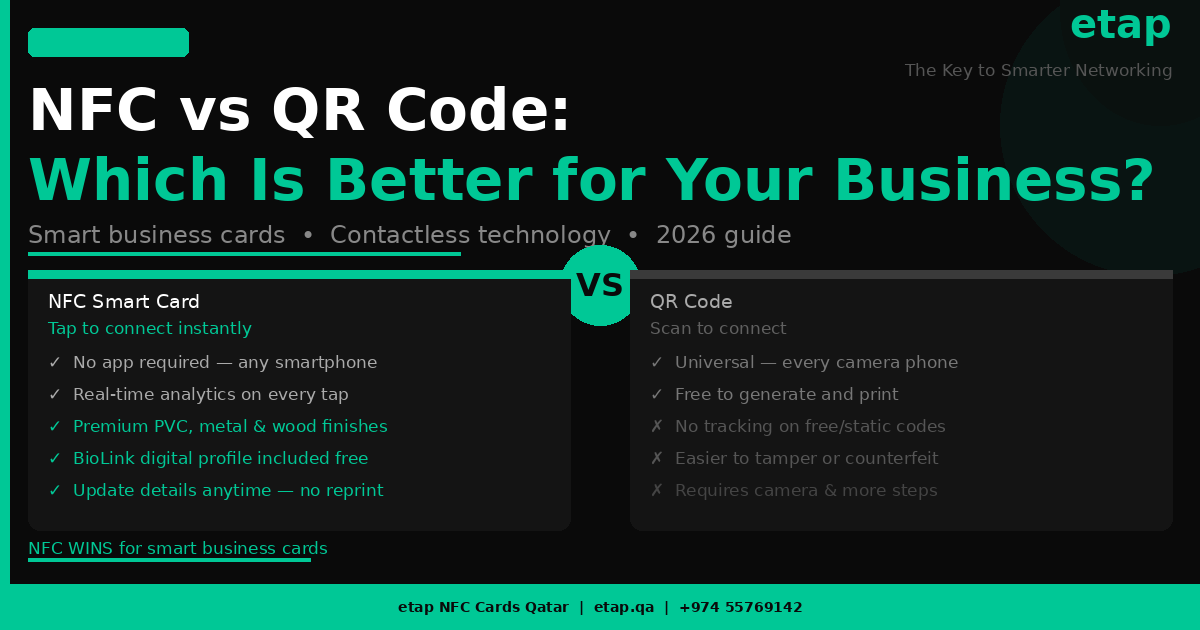
In today’s fast-moving business world, how you share your information matters more than ever. The days of handing someone a paper card and hoping they keep it are fading fast. Two powerful contactless technologies have taken over: NFC and QR codes.
Both are smart. Both are fast. Both are infinitely better than paper. But when it comes to choosing between them for your smart business card, customer engagement system, or contactless card solution — which one actually wins?
This guide breaks it all down honestly, so you can make the right choice for your business.
Understanding NFC: The Tap Technology
NFC stands for Near Field Communication. It is a short-range wireless technology that lets two devices exchange data when placed within a few centimetres of each other.
You already use NFC every day without thinking about it. When you tap your debit card on a payment terminal, wave your phone to pay for groceries, or use Apple Pay or Google Pay — that is NFC working in the background. It is one of the most reliable, secure, and widely deployed wireless technologies in the world.
In the context of smart business cards and contactless solutions, NFC works through a tiny chip embedded inside a physical card. When someone holds their smartphone near your NFC card, the chip activates and transmits data instantly — opening your digital profile, website, contact page, or any custom destination in under two seconds. No camera required. No apps needed. Just tap.
Modern NFC smart business cards are available in premium materials — PVC, metal in finishes like gold, silver, black, and rose gold, and even wood. Each card is typically paired with a personalised digital profile page (commonly called a BioLink) that the cardholder can update at any time without reprinting the card.
Understanding QR Codes: The Scan Technology
A QR code (Quick Response code) is a two-dimensional matrix barcode that a smartphone camera reads by scanning. Once scanned, the code typically opens a URL, launches a contact save, or triggers another digital action.
QR codes became truly ubiquitous during the pandemic years when restaurants, check-in systems, and payment platforms adopted them at speed. Today, you find them on menus, packaging, billboards, receipts, and product labels worldwide.
Unlike NFC, QR codes require no embedded chip. They are simply a printed pattern — which makes them essentially free to generate and add to any printed material, digital display, or surface.
NFC vs QR Code: Eight-Factor Comparison
Factor 1: Speed and Ease of Use
With NFC, the interaction is as close to instant as technology allows. The user holds their phone near the card — no camera app, no scanning, no focusing required. The result appears on screen in under two seconds. For someone unfamiliar with the technology, it genuinely feels like magic.
With a QR code, the process requires a few more steps: open the camera or QR scanner app, hold the phone steady over the code, wait for recognition, and tap the link that appears. On modern smartphones, this takes around three to five seconds — fast by any objective measure, but noticeably slower than NFC when the two are compared side by side.
Winner: NFC — marginally but meaningfully faster and more frictionless.
Factor 2: Device Compatibility
NFC is supported on all iPhones from the iPhone 7 onwards and virtually every Android smartphone produced after 2015. This covers the vast majority of active smartphones globally. However, a small number of older or budget devices may not support NFC, and some users may have NFC switched off in their settings.
QR codes work on every smartphone equipped with a camera — which is essentially every smartphone ever made. No special hardware, no settings, no compatibility concerns whatsoever.
Winner: QR code — universal compatibility with zero exceptions.
Factor 3: Smart Business Cards and Professional Networking
This is where the comparison becomes most relevant for professionals and businesses.
An NFC smart business card creates a genuinely memorable moment. You hand someone a sleek metal or premium PVC card, they tap it on their phone, and your full digital profile opens instantly — name, title, phone, email, WhatsApp link, LinkedIn, Instagram, portfolio, website — everything, in one tap. The interaction is smooth, impressive, and modern. Recipients almost always comment on it.
A QR code business card is effective and professional. The QR code is printed on the card alongside your traditional details. The recipient opens their camera, scans, and accesses your digital content. It works well, but it requires more active effort from the recipient and creates less of a memorable moment.
Many premium smart business card providers now combine both technologies in a single card — an NFC chip for tap-to-share, QR code printed on the card as a backup. This is the best of both worlds, ensuring that every recipient can access your information regardless of their phone or settings.
Winner: NFC for impact and experience — QR code as an essential backup.
Factor 4: Cost
Generating a QR code is free. Hundreds of free online tools create them in seconds. Adding a QR code to printed materials — cards, menus, posters, packaging — adds virtually no production cost. For dynamic QR codes that can be updated after printing, a monthly subscription to a QR management platform is typically required.
NFC smart business cards require an embedded chip, which adds to the unit cost. Quality NFC business cards start at around USD 40–50 for a single premium card, though the cost per card reduces significantly with larger orders. Importantly, this is a one-time cost — the card itself never needs replacing or reprinting when your details change.
Winner: QR code for upfront cost. NFC for long-term value and premium positioning.
Factor 5: Analytics and Tracking
Both technologies can offer excellent analytics — but the implementation differs.
With NFC smart business cards from quality providers, every tap is tracked automatically through the connected digital profile platform. You can view in real time how many people tapped your card, when, from which device, and from which country. For sales professionals and business development teams, this data is actionable and genuinely valuable.
With QR codes, tracking is available only through dynamic QR codes on paid platforms. Static QR codes — the free kind — offer no analytics at all. Dynamic QR code platforms show scan counts, device types, and locations.
Winner: Tie — both offer strong analytics when using premium platforms. NFC tracking is typically included as standard.
Factor 6: Durability
An NFC chip is sealed inside the card body and is extremely durable under normal use. Premium metal NFC cards are built to last years without performance degradation. The chip does not wear out through daily use.
A printed QR code is only as durable as the surface it lives on. Scratches, fading, folding, water damage, or general wear can render a QR code unreadable. On high-quality laminated cards, this is less of a concern, but in outdoor, high-traffic, or high-wear environments, printed codes can degrade.
Winner: NFC — more reliably durable for long-term daily use.
Factor 7: Security
NFC technology supports encryption at the chip level. For access control applications — hotel key cards, office entry systems, attendance tracking, and membership systems — NFC chips such as Mifare offer encryption that makes them extremely difficult to duplicate or compromise.
QR codes have no inherent security. They can be photographed, reproduced, and overlaid with fraudulent versions relatively easily. There are documented real-world cases of criminals placing fraudulent QR code stickers over legitimate ones in public spaces to redirect unsuspecting users to phishing pages.
Winner: NFC — significantly more secure, especially for access control and payment-adjacent applications.
Factor 8: Environmental Impact
A single NFC smart business card replaces potentially thousands of paper cards over its lifetime. When your contact details change, you update your digital profile — the card stays the same. No reprinting, no waste.
QR codes generated digitally and shared via screen have zero material impact. When printed on paper cards, menus, or packaging, they contribute to the same environmental cost as any printed material.
Winner: NFC for business cards. QR code for purely digital or screen-based deployment.
When Should You Choose NFC?
NFC is the right primary technology when:
You attend regular professional networking events, meetings, or conferences and want to make a strong, lasting impression. You want real-time analytics on who engages with your card and when. You need a long-term investment that never becomes outdated. You are in a client-facing or senior professional role where the quality of every touchpoint reflects on your personal brand or company. You are deploying access control, hotel key systems, attendance tracking, or membership verification where security matters.
When Should You Choose QR Codes?
QR codes are the right primary choice when:
You need maximum compatibility across every possible phone and user type without exception. You are working with printed materials at scale — restaurant menus, product packaging, posters, event signage — where embedding NFC chips is impractical or prohibitively expensive. Budget is the primary constraint, and upfront cost must be minimised. You need an outdoor or high-volume application where QR codes can be printed cheaply and replaced easily.
The Smartest Choice: Use Both Together
The most effective approach for modern businesses is not NFC or QR code — it is NFC with a QR code backup. And this is exactly how the best smart business card solutions are designed.
A premium contactless business card includes an NFC chip for instant tap-to-share, a printed QR code for camera-based access, a direct shareable URL for WhatsApp and email sharing, and a connected digital profile with real-time analytics. Every possible contact scenario is covered — regardless of the recipient’s phone model, settings, or familiarity with the technology.
etap, one of Qatar’s leading smart card and NFC solutions companies, builds every NFC business card with both technologies combined. Their premium contactless cards — available in PVC, metal, and wood finishes — include NFC, QR code, a personalised BioLink digital profile, and real-time analytics as standard. More information is available at etap.qa.
Final Verdict
For professional networking and smart business cards: NFC delivers a superior experience, stronger analytics, greater durability, and a more impressive first impression. It is the professional choice.
For mass-market print, signage, and packaging at scale: QR codes win on cost and universal compatibility.
For businesses that want the complete solution: combine both. An NFC smart business card with a QR code backup covers every scenario and every recipient — which is exactly what serious modern businesses should be using in 2026.
The question is not really NFC vs QR code. The question is: why would you choose only one when the best solution gives you both?