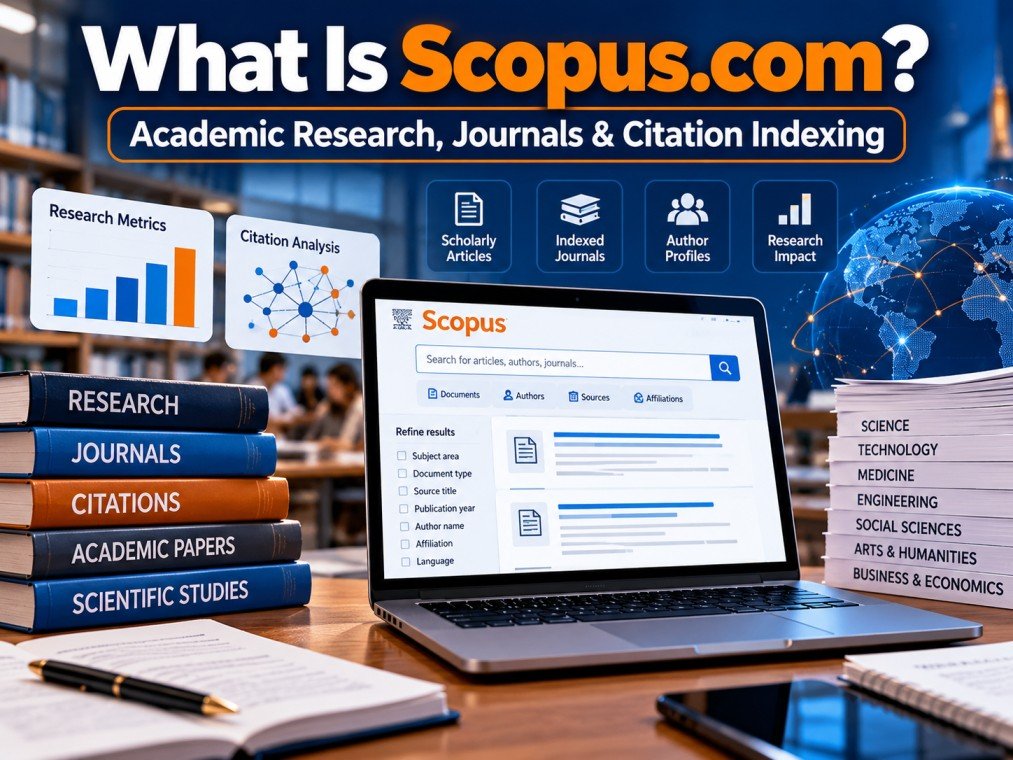
Academic research plays a vital role in education, scientific discovery, and professional development. Researchers, university students, professors, and academic institutions need reliable ways to discover scholarly publications, evaluate research impact, and identify relevant studies. This is where Scopus becomes an important resource.
Scopus.com is the online platform for Scopus, an abstract and citation database developed by Elsevier. It helps users discover academic literature, explore author profiles, track citations, and analyze research trends across multiple disciplines.
Whether you are a student preparing a dissertation, a researcher writing a journal paper, or an academic institution evaluating research performance, understanding how Scopus works can help you make better-informed research decisions.
What Is Scopus.com?
Scopus.com is associated with Scopus, a multidisciplinary database that indexes scholarly literature, including journal articles, conference proceedings, books, and other research materials.
Unlike a general search engine, Scopus focuses on structured academic information. It connects publication records with abstracts, references, author information, institutional affiliations, and citation data. This makes it useful for finding relevant research and understanding how published work relates to other studies.
Researchers can use the platform to explore subjects such as:
-
Science and technology
-
Medicine and health research
-
Engineering and computer science
-
Business and economics
-
Social sciences
-
Arts and humanities
The available content depends on the database’s coverage and the publication’s indexing status.
Key Features of Scopus.com
Scopus provides several features that support academic research, publication discovery, and research evaluation.
1. Academic Literature Search
One of the main functions of Scopus is helping users find scholarly publications related to a particular topic. Users can search using keywords, article titles, author names, and other available search fields.
For example, someone researching artificial intelligence in education could use relevant search terms to discover previous studies, review abstracts, and identify related publications.
Effective search techniques include using specific phrases, combining keywords, and refining results by publication year, subject area, or document type when those filters are available.
2. Citation Tracking
Citation tracking helps researchers understand how frequently a publication has been cited by other indexed documents.
By examining citation relationships, users can discover research that builds on an earlier study, identify related work, and explore how an academic topic has developed over time.
However, a high citation count does not automatically mean that a study is accurate or scientifically superior. Citation numbers should be interpreted alongside research quality, methodology, relevance, and the context of the field.
3. Scopus Author Profiles
Scopus Author Profiles organize publication information associated with individual researchers. Depending on the available record, a profile can include publications, affiliations, subject areas, co-authors, and citation information.
These profiles can help researchers:
-
Review their indexed publication history
-
Discover researchers working on similar topics
-
Explore potential research collaborations
-
Examine citation information
-
Identify possible errors in publication attribution
Author profiles are generated from indexed publication metadata, so records may occasionally require correction. Researchers should verify that publications and affiliations have been assigned correctly.
4. Journal Metrics and Research Analytics
Scopus includes tools and metrics that help users assess scholarly publication activity. One example is CiteScore, a journal-level metric based on citations received by documents published in a defined period.
Researchers and librarians can use these metrics to compare publication sources, explore research performance, and support collection or publishing decisions.
Metrics are useful indicators, but they should not be treated as the sole measure of research quality. Comparisons are more meaningful when they account for differences between disciplines, publication types, and citation practices.
How to Use Scopus.com for Academic Research
Getting started with Scopus is straightforward. The steps below can help students and researchers build an effective research workflow.

Step 1: Visit the official website
Open Scopus.com to access the platform. Some features are available through Scopus Preview, while full search functionality may require a subscription or institutional access.

Step 2: Search for a research topic
Enter keywords, a paper title, or an author’s name. Use focused search phrases to find publications relevant to your research question.

Step 3: Review publication details
Examine article titles, abstracts, authors, publication dates, and references to decide which papers are relevant to your research.

Step 4: Explore citations and related studies
Follow citation links and investigate related publications to discover additional sources and understand how the research connects to earlier work.
What Is a Scopus-Indexed Journal?
A Scopus-indexed journal is a journal whose eligible content is included in the Scopus database. Journals are evaluated through a selection process that considers factors such as editorial policy, peer review, academic contribution, publishing regularity, and online availability.
Researchers often look for indexed journals when selecting where to submit their work. However, journal selection should involve more than checking whether a journal appears in a database.
Before submitting a manuscript, consider the following:
-
Scope and relevance: Does the journal publish research in your subject area?
-
Peer-review policy: Is the review process clearly explained?
-
Publication standards: Are editorial practices and publication fees transparent?
-
Current indexing status: Is the journal currently covered by Scopus?
-
Publisher credibility: Does the publisher provide verifiable editorial and contact information?
How to Check Whether a Journal Is Indexed in Scopus
Use the official Scopus Sources directory to search for a journal by its title or ISSN. Check the source record, coverage years, and available metrics.
Do not rely only on a journal’s claim that it is indexed. Coverage can change, and a journal’s historical presence in the database does not necessarily mean that all current issues are covered.
Scopus vs. Google Scholar: What Is the Difference?
Scopus and Google Scholar both help people discover academic literature, but they serve somewhat different purposes.
| Feature | Scopus | Google Scholar |
|---|---|---|
| Primary purpose | Curated abstract and citation database | Broad scholarly search engine |
| Content coverage | Selected scholarly sources | Wider range of academic and scholarly materials |
| Author profiles | Structured Scopus Author Profiles | Google Scholar author profiles |
| Citation analysis | Citation and research analytics tools | Citation counts and related tools |
| Access | Some preview features; fuller access may require a subscription | Generally free to search |
| Journal evaluation | Provides source information and metrics | Not a journal-indexing certification system |
The most suitable platform depends on the research task. Scopus can be useful for structured literature searches and research analytics, while Google Scholar can help users discover a broader range of scholarly materials.
Neither database guarantees that every result is relevant, reliable, or methodologically sound.
Is Scopus.com Free to Use?
Scopus offers free access to selected features through Scopus Preview. These features can help users explore source information, view certain author details, and access available CiteScore information. More extensive searching and other advanced features may require a subscription or institutional access.
Students and researchers should check whether their university or research institution provides access through its library. Access rights can vary depending on the institution’s subscription.
If full access is unavailable, researchers can also explore open-access publications, university repositories, and official publisher websites to locate research articles.
Benefits of Scopus for Students, Researchers, and Universities
Scopus can support several academic activities when used appropriately.
For Students
Students can discover relevant literature, identify research gaps, find references for dissertations, and learn how academic studies connect to one another.
For Researchers
Researchers can track citations, identify related publications, explore potential collaborators, and examine publication activity within their fields.
For Universities
Institutions can use Scopus data and analytical tools to examine research output, understand collaboration patterns, and inform research planning.
For Academic Librarians
Librarians can use source information and publication metrics to support collection development and help researchers locate relevant scholarly resources.
The value of these tools depends on the quality of the underlying records and how carefully the results are interpreted.
Common Mistakes to Avoid When Using Scopus
Even experienced researchers can make mistakes when searching databases or evaluating research performance.
-
Relying only on citation counts: Citations are indicators, not definitive proof of research quality.
-
Assuming every indexed paper is flawless: Peer review and indexing do not eliminate errors or limitations.
-
Ignoring indexing coverage dates: A source may have coverage gaps or may no longer be actively indexed.
-
Confusing Scopus with a publisher: Scopus indexes publication information; it is not the publisher of every article in its database.
-
Overlooking alternative sources: A paper that is absent from Scopus may still be legitimate and valuable.
-
Failing to verify author profiles: Similar names can lead to publication attribution errors.
A careful approach combines database searches with critical reading, source verification, and sound academic judgment.
Frequently Asked Questions About Scopus.com
1. What is Scopus.com used for?
Scopus.com provides access to the Scopus academic abstract and citation database, which supports scholarly literature searches, citation tracking, author discovery, and research analytics.
2. Is Scopus a journal or a database?
Scopus is a database, not a journal. It indexes information from selected scholarly journals, books, conference proceedings, and other eligible research sources.
3. How can I check a journal’s Scopus indexing status?
Search for the journal in the official Scopus Sources directory and review its source details and coverage information.
4. Does Scopus provide full-text research papers?
Scopus primarily provides abstracts, citation data, and publication metadata. Some records link to full text on publisher websites or through institutional library services, depending on availability and access rights.
5. Can students use Scopus for free?
Students can access selected features through Scopus Preview. Full access to additional features may depend on a subscription or their institution’s access arrangements.
6. Does a high Scopus citation count guarantee high research quality?
No. Citation counts show how often indexed work has been cited, but they do not independently establish accuracy, originality, or scientific quality.
Conclusion
Scopus.com is a valuable resource for discovering scholarly literature, exploring author profiles, tracking citations, and analyzing academic publication activity. Its structured database and research tools can help students, researchers, librarians, and universities make more informed decisions.
To use Scopus effectively, combine targeted searches with careful evaluation of journal coverage, research methods, publication details, and citation context. Always verify current indexing information through official sources and remember that metrics are only one part of evaluating academic work.
With a thoughtful research strategy, Scopus can become a useful part of the academic research process, helping users discover relevant studies and build a stronger understanding of their chosen subjects.